
OFA/CAER Eye Certifications
A comprehensive screening exam to check for hereditary eye disease. Results are reviewed by the OFA and a OFA Eye Certification Registry (ECR) Certificate valid for 1 year is issued.

About Our OFA/CAER Eye Certifications for Dogs
OFA Eye Exams (formerly called CERF exams, now called Companion Animal Eye Registry, or CAER, exams) are standardized eye screening exams that check for heritable eye disease in pure-bred dogs.
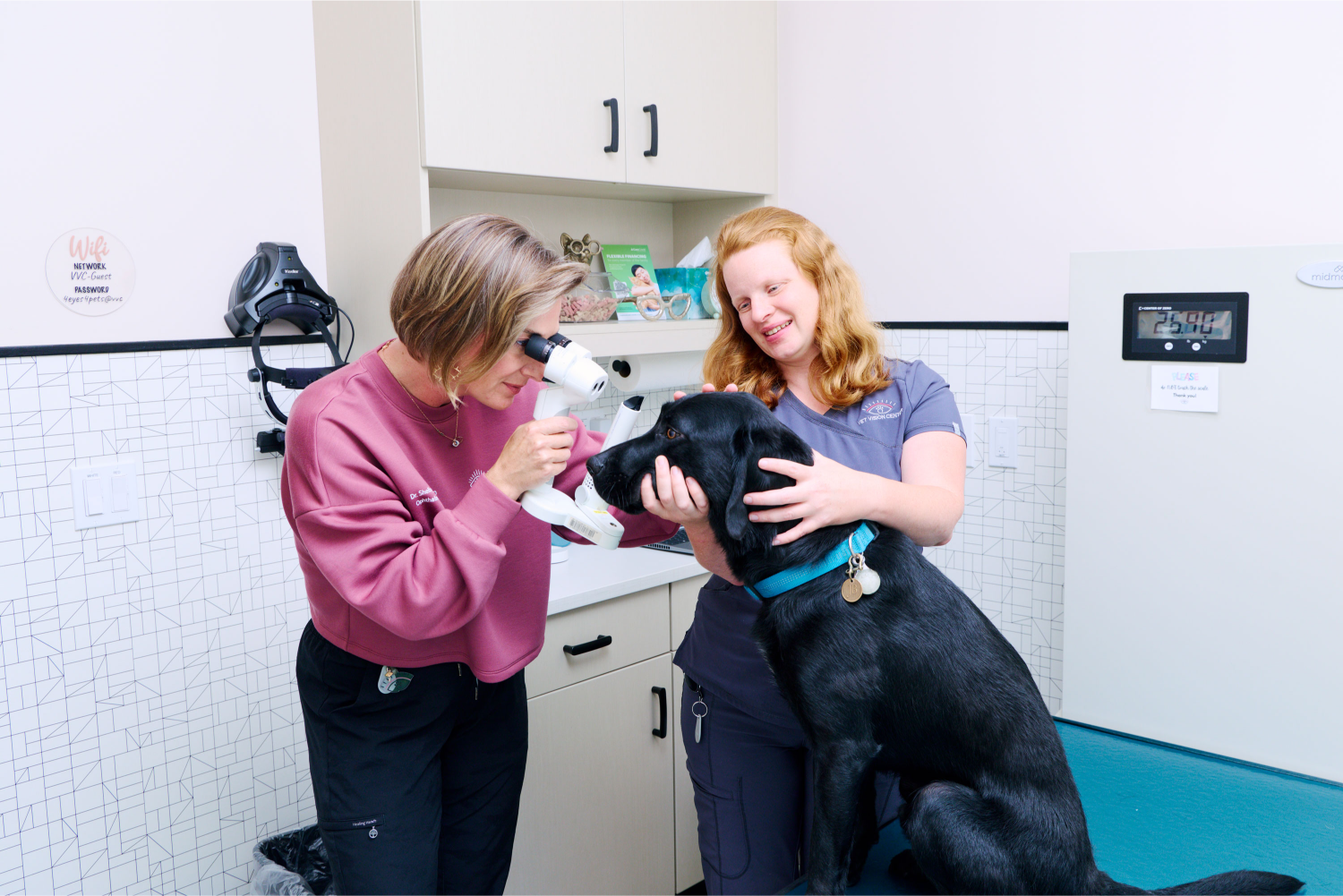
The exam includes a dilated slit lamp examination and binocular fundic examination performed by a board-certified veterinary ophthalmologist like Dr. Reinstein, with results submitted to the OFA database so breeders can make informed breeding decisions.
This is a wellness service for breeders; not an emergency, not for pet owners looking for clinical answers.
Related Condition:Progressive Retinal Atrophy in Dogs
Progressive Retinal Atrophy (PRA) is an inherited degeneration of the retina’s light-perceiving cells (similar to macular degeneration in people); dogs first struggle in dim light and progress slowly to complete blindness, always in both eyes.
What the CAER Exam Is
The CAER (Companion Animal Eye Registry) exam is the standard screening exam for hereditary eye disease in dogs. A board-certified veterinary ophthalmologist — that’s us; Dr. Reinstein is ACVO-credentialed — examines your dog’s eyes for the inherited conditions known to occur in their breed. Owners may elect to submit (or not submit) results into the OFA’s public registry for informed breeding decisions.
Who should get one
- Breeding dogs — before first mating, then annually for life (as some genetic conditions don’t appear until later in life).
- Show and sporting dogs pursuing CHIC or breed-club health certifications.
If you’re planning a litter, running a kennel, or working toward CHIC certification, a current CAER exam is part of how you protect the breed.
What to expect at your visit
Here's how to prepare for your OFA/CAER visit, whether you're bringing a single dog or a whole litter. Please plan to arrive 15 minutes before your appointment time.
-
Step 1: Arrive & Check In
Come to the front desk first to let us know you’re here. For puppy litters (and any group of 3 or more dogs), please keep the pups in easy-to-carry crates and check in before bringing them inside. If you’re bringing just 1–2 adult dogs, you’re welcome to come in with them.
-
Step 2: Meet Your OFA Nurse
Our OFA nurse will greet you, help you get everyone inside, and briefly review each dog’s breed, age, prior exams, and any known hereditary eye conditions in the line.
-
Step 3: Complete a form for each dog
You’ll fill out a short form per dog: call name, registration name (if known), breed, microchip or AKC number, and owner/co-owner information. For puppies that aren’t yet microchipped or registered, please note a way to tell them apart, like “pink collar” or “brown boy with white paw.”
-
Step 4: Dilation & Exam
We’ll place a dilating drop in each dog’s eyes, which takes about 15 minutes to take effect. Once dilated, Dr. Reinstein performs the screening exam. The CAER exam form is completed by the doctor and you are provided a hard copy at the time of the visit.
Frequently Asked Questions about OFA/CAER Eye Certifications for Dogs
The CAER (Companion Animal Eye Registry) exam is the standardized hereditary eye-disease screening administered through the Orthopedic Foundation for Animals (OFA). A board-certified veterinary ophthalmologist performs a complete ophthalmic exam, then submits the results to OFA for issuance of the CAER Certificate — used by breeders, breed clubs, and CHIC certification programs.
A genetic test like Embark tells you whether a dog carries known disease-causing genes. A CAER exam tells you what the dog’s eye looks like right now — including non-genetic conditions and conditions without a known gene. They’re complementary: genetics screens the lineage, CAER confirms the phenotype. Most serious breeders use both.
Not necessarily. CAER results are reported by condition, and not all conditions result in a fail. Some hereditary findings are designated “breeder option,” and some conditions are considered not inherited. Your ophthalmologist walks through what each result means for your specific breed.
OFA does run a Feline CAER program for hereditary eye disease in pedigreed cats, however VVC does not offer feline screening.
Our CAER screening fee is listed at the front desk and quoted when you book. Pricing is different for adult dogs versus full-litter exams. OFA’s registry fee to obtain your certificate is separate and paid by you when your exam is submitted.
From Dr. Shelby:
About OFA Exams
Dr. Shelby is honored to provide Orthopedic Foundation for Animals (OFA) eye exams because these screenings are a crucial proactive tool to reduce the prevalence of blinding genetic eye diseases. By identifying heritable conditions like cataracts and progressive retinal atrophy (PRA) before a dog is bred, I can help breeders make informed decisions that prevent passing diseases onto future puppies.

Dr. Shelby Reinstein
Founder and board-certified veterinary ophthalmologist, Dr. Reinstein leads Vet Vision Center.
Let’s take care of your pet’s vision — together.
If something doesn’t feel right, you don’t have to wait. Schedule an appointment or give us a call. We’re here to help you find answers and next steps with clarity and care.